Advertisements

Showing posts with label Disaster Management in India. Show all posts

September 14, 2013

All Topics of Disaster Management for APPSC Government jobs


This section covers the topics of disaster management for competitive exams where suitable weightage is given. The topics on the blog are review as given below.


 >> Major Disasters in India

Advertisements

Some Important Terms for preparing questions of Disaster Management

Disaster Management: the  range   of activities  designed to  mitigate  the  effects  of disasters and  emergency situations and  to  provide  a  framework for  helping  people   at-risk  to  avoid  or recover   from  the  impact  of  the  disaster. Managing  disasters includes  steps to  be  taken   prior to,  during,  and  after  the  disaster, and  involve  preparedness,  mitigation, response and  recovery.

Disaster-proneness:  the   likelihood  of  a  place   being   affected  by  a  disaster

Natural Hazard: A  physical  event   or  phenomena which  may  cause   injury  or  loss  of  life, damage  to  property,  social  and   economic   disruption  or  environmental  degradation

Vulnerability: in simple  terms  is the  potential for loss  to  an  individual,  community  or  place because  of  a  disaster,  which  is  affected  by  geographical  as   well  as   social  conditions

Disaster Preparedness:

Advertisements

June 24, 2013

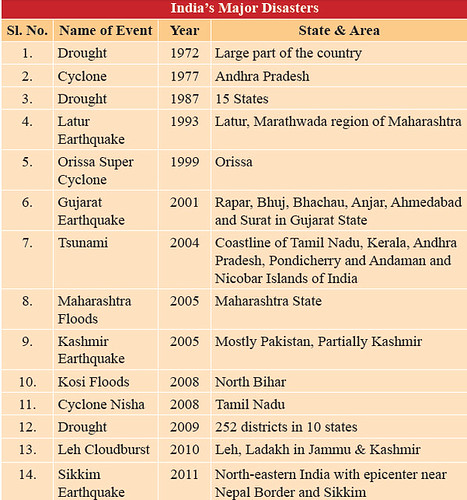
Major Disasters in India

Major Disasters in India

Advertisements

Management of Disasters in India

DISASTERS AFFECT almost every part of the world. According to a World Bank report titled “natural hazards, unnatural disasters,” floods and storms are the most widespread while droughts are prevalent more often in Africa. Regions which suffer from frequent droughts and floods are also home to most of the hungry in the world. Climate change is expected to exacerbate the situation. There is, therefore, a need to recognize hazards and vulnerability in a comprehensive manner and take effective steps for prevention, mitigation and management.
Management of Disasters in India
In the case of India, natural disasters like floods, cyclones and drought occur repeatedly in different parts of the country. Many districts of India are prone to multiple hazards and face different disasters around the year. Earthquake, hailstorms.

Advertisements

THE DISASTER MANAGEMENT ACT, 2005 - Full Bare Act


NO. 53 OF 2005 [23rd December, 2005]
An Act to provide for the effective management of disasters and for matters connected therewith or incidental thereto.
BE it enacted by Parliament in the Fifty-sixth Year of the Republic of India as follows:-
(1)  This Act may be called the Disaster Management Act, 2005.
(2)   It extends to the whole of India.
(3)    It shall come into force on such date as the Central Government may, by notification in the Official Gazette appoint; and different dates may be appointed for different provisions of this Act and for different States, and any reference to commencement in any provision of this Act in relation to any State shall be construed as a reference to the commencement of that provision in that State.

Advertisements

June 23, 2013

The highlights of the Disaster Management Act, 2005

1. Creation of new institutions at National level, State level and District level as follows:
i) National Disaster Management Authority (NDMA)
ii) State Disaster Management Authority (SDMA)
iii) District Disaster Management Authority (DDMA)
 2. Constitution of National Disaster Response Force (NDRF)
3. Setting up of National Disaster Reserve funds and State Disaster Reserve Fund for immediate response
work
4. Formation of National Institute of Disaster Mitigation (NIDM) for building the capacities of various stake
holders involved in Disaster Mitigation and Response programs
5, Multi-stakeholder participation of Corporates and NGOs in the Disaster Relief, Rehabilitation, Mitigation
and Risk Reduction work
6. A National Executive Committee (NEC) was constituted under the NDMA with Union Home Secretary as
the Chairperson to monitor, co-ordinate and oversee the functions of the Departments concerned with
respect to Disaster Mitigation
7. The State level Relief and Rehabilitation Departments were renamed as Department of Disaster
Management and held responsible for Disaster Mitigation, Risk Reduction, Preparedness and early
Response

Advertisements

Calamities included under National Disaster Management Act - First Schedule List & Second Schedule for Nodal Ministries to various types of Disasters

“Disaster” means a catastrophe or calamity, resulting from natural or man made causes or by accident or negligence, which results in substantial loss of life or property, or human suffering or degradation of environment and shall include the calamities referred to in the First Schedule and does not include incidents  like riots, wars, terrorist activities, etc.
The First Schedule
CALAMITIES
Water and Climate Related Calamities
1. Flood or drainage
2. Cyclone
3. Hurricane
4. Hailstorm
5. Cloud burst
6. Heat wave
7. Cold wave
8. Drought
9. Crop failure
10. Famines
11. Sea erosion
12. Snow storm
13. Blizzard
14. Sand storm
15. Thunder or lightning
Geologically Related Calamities
16. Landslides, rock-slides or mudflows
17. Earthquakes
18. Avalanche
19. Volcanic eruptions
20. Rivers changing path
Chemical, Industrial and Nuclear Related
Calamities
21. Chemical and industrial disasters
22. Nuclear disasters
Accident Related Calamities
23. Forest fires
24. Urban fires
25. Mine flooding or mine fires or mine collapse
26. Oil spill
27. Building collapse
28. Dam failures/dam bursts
29. Festival related disasters
30. Fire and electrical disasters
31. Air, road and train accidents
32. Boat capsizing
33. Village fire
Biologically Related Calamities
34. Biological disasters and epidemics
35. Pest attacks
36. Cattle epidemics
37. Food poisoning

The Second Schedule -NODAL MINISTRIES

Drought
Ministry of Agriculture
Epidemics & Biological Disasters
Ministry of Health and Family Welfare
Chemical Disasters
Ministry of Environment & Forests
Nuclear Disasters
Ministry of Atomic Energy
Air Accidents
Ministry of Civil Aviation
Railway Accidents
Ministry of Railways


Advertisements

Susceptibility of India to Natural Disasters in India based on types of disasters

Earthquakes: During the last 20 years, India has experienced 10 major earthquakes that have claimed more than 35,000 lives. Almost 58% of our total land mass is prone to earthquakes of moderate to very high intensity. The Himalayan mountain range is undergoing constant geological changes (crustal movements) resulting in frequent earthquakes and landslides.
Floods: Floods in the Indo-Gangetic – Brahmaputra plains are an annual feature.  Several thousands of lives have been lost, millions have been rendered homeless and 8 million hectares of crops are damaged every year.  India receives 75% of rains during the monsoon season (June – September). As a result almost all the rivers carry heavy waters during this time resulting in sediment deposition, drainage congestion, invading into the main land. 40 million hectares of land is vulnerable to floods with about 30 million people affected by flood every year.  Floods brought severe drought in arid and semi arid areas. About 12% of the total land mass is flood prone.
Cyclones: India has a long coastline running 7,516 km long and the entire coastal stretch is exposed to Tsunami, cyclone, Tidal waves and storm surges. On an average, five to six tropical cyclones strike every year, of which two or three are very severe. More cyclones occur in the Bay of Bengal than in the Arabian Sea and the ratio is approximately 4:1. Every year the eastern coast is affected by cyclones and Tsunami. The Orissa Super Cyclone (1999) and the India Tsunami 2004 claimed thousands and thousands of human lives devastating agricultural crops and rendering lakhs and lakhs of people homeless.
Drought: The Desert which is located in the western region of the country and the Deccan Plateau face recurring droughts due to acute shortage of rainfall. About 50 million people are affected annually by drought and 40 million hectares of land are prone to scanty or no rain.
Landslides: Landslides are yet another recurrent phenomenon in the hilly regions of India such as Himalayas, North-East India and Eastern and Western Ghat regions. The major Landslide disaster that took place was at Malpa Uttarkhand (UP) in the year 1998 when nearly 380 people were killed when massive landslides washed away the entire village. The 2010 Leh cloudburst led to flash mudslides and flash floods that killed 196 people swept away a number of houses and public buildings.
Cold waves: Cold waves are common and recurrent disaster in North India. During the winter season due to extreme cold climates, hundreds of people die of cold bites and related diseases every year. The impact is more on the urban poor.

Advertisements

Total Loss dues to Natural disasters in India

Natural Disasters from 1980 – 2010   -    An Overview

Over View

No of events

                 431

No of people killed:                 143,039
Average killed per year:                 4,614
No of people affected:                1,521,726,127
Average affected per year:                49,087,940
Economic Damage (US$ X 1,000):                48,063,830
Economic Damage per year (US$ X 1,000):                1,550,446

Advertisements

Major Disasters that struck India in the recent decades

 
1. Uttarkashi Earthquake in  1991
2. Killani Earthquake in 1993
3. Latur Earthquake in Maharashtra  in 1993
4. Koyama Earthquake in 1997
5. Chamoli Earthquake in Uttarakhand in 1999
6. Super Cyclone in Orissa in 1999
7. Bhuj Earthquake in 2001
8. Indian Ocean Tsunami in 2004
9. Kashmir Earthquake in 2005
10. Barmer Floods in Rajasthan in 2006
11. Kosi Floods in Bihar in 2008
12. Cyclone Aila in West Bengal in 2009
13. Cyclone Laila in Andhra Pradesh in  2009
11. Cloudburst in Leh in 2010
12. Thane Cyclone in Tamil Nadu and Puducherry 2011
 

Advertisements

Followers