Advertisements
Showing posts with label Physics & Chemistry. Show all posts
Showing posts with label Physics & Chemistry. Show all posts
December 8, 2015

November 7, 2015

September 5, 2015
Part 9- 85+ Chemistry bits for Competitive Exams(TM)
Labels:
Physics & Chemistry
Chemistry bits in Telugu Medium for APPSC Exams

.JPG)
Advertisements

June 26, 2015
Part 8: 45+ Bits in Physics for General Studies Telugu Medium
Labels:
Physics & Chemistry

Advertisements
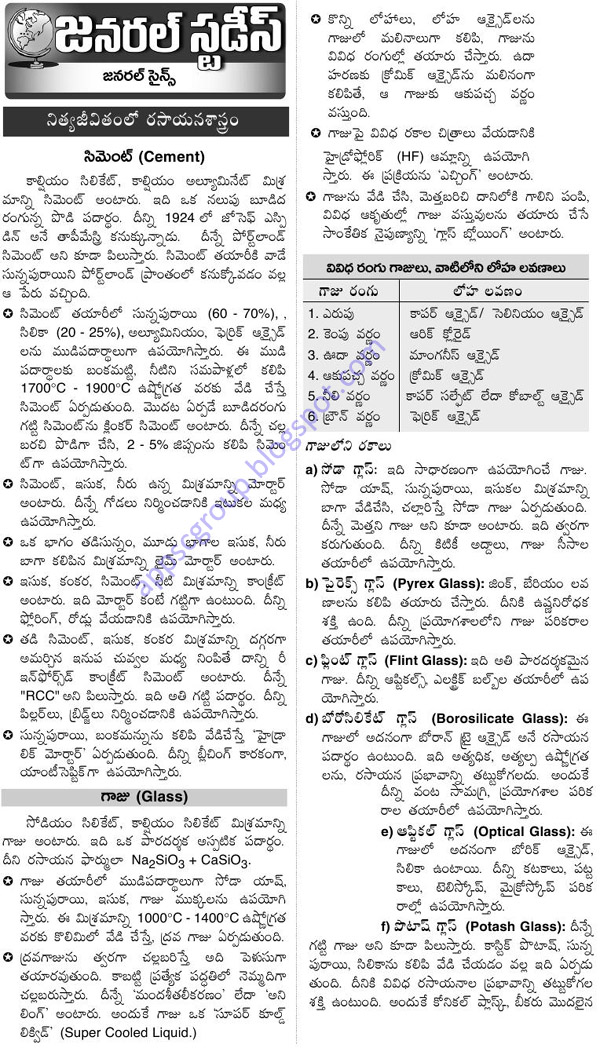
Cement, Glass, Soap & Detergent - Common Chemistry Explained(TM)
Labels:
Physics & Chemistry
Advertisements
October 2, 2014
23+ Chemistry Quiz's -Practice Yourself for Civil Service Exams
Labels:
Chemistry Quiz,
Index Pages,
Physics & Chemistry
Biology Objective Bit Bank from Various Competitive Exams,
GK Quiz Multiple Choice Questions with answers asked in Many Civil Service
Exams with Key, Quiz on General Knowledge, GK Test, Questions & Answers for UPSC IAS, SSC
Tier 1, Bank PO Clerical, Railway RRB, APPSC, APSPSC & TPSC
All the Questions provided here are collected from previous years
competitive exams papers. So the users are advised to attempt every question
and feel confident for upcoming exam.
|
Chemistry
-GK Quiz for Civil Service Exams
|
Advertisements
21+ Physics Quiz's -Practice Yourself for Civil Service Exams
Labels:
Index Pages,
Physics & Chemistry,
Physics Quiz
Objective Bit Bank from Various
Competitive Exams, General Science Chemistry, Physics & Biology Questions
asked in Many Civil Service Exams with Key, Quiz on General Knowledge, GK Test,
Questions & Answers for UPSC IAS,
SSC Tier 1, , Bank PO Clerical, Railway RRB, APPSC & TPSC
All the Questions provided here are collected from previous years competitive exams papers. So the users are advised to attempt every question and feel confident for upcoming exam.
Physics
-GK Quiz for Civil Service Exams
|
Advertisements
September 27, 2014
Quiz 11- Physics -General Science: General Knowledge Question & Answers
Labels:
Physics & Chemistry,
Physics Quiz
101 Q) "Which one among the following correctly defines a unit magnetic pole in SI units?
It is the pole which when placed in air at a distance of
"
(a)1 foot from an equal and a similar pole repels it with a force of 1 pound
(b)1 metre from an equal and similar pole repels it with a force of 1 newton
(c)1 cm from an equal and a similar pole repels it with a force of 1 dyne
(d)1 metre from an equal and a similar pole repels it with a force of 1 newton/m2
102 Q) "When you pull out the plug connected to an electric appliance, you will often observe a spark. To which property of the appliance is this related?.
"
(a) Resistance
(b) Inductance
(c) Capacitance
(d) Wattage

103 Q) "The scent sprayer is based on
"
(a) Carle's law
(b) Boyle's law
(c)Archimede's principle
(d)Bernoulli's theorem
Advertisements
September 24, 2014
Quiz 2- Chemistry-General Science: General Knowledge Question & Answers
Labels:
Chemistry Quiz,
Physics & Chemistry
11 Q) The charcoal use to decolourise raw sugar is
(a) animal charcoal
(b)sugar charcoal
(c) coconut charcoal
(d) wood charcoal
12 Q) The most abundant metal in the earth’s crust is
(a) zinc
(b) copper
(c) aluminium
(d) iron
 13 Q) Production of chlorofiuorocarbons (CFC) gas which is proposed to be banned in India, is used in which of the following domestic products ?
(a) Television
(b) Tubelight
(c) Cooking gas
(d) Refrigerator
(a) animal charcoal
(b)sugar charcoal
(c) coconut charcoal
(d) wood charcoal
12 Q) The most abundant metal in the earth’s crust is
(a) zinc
(b) copper
(c) aluminium
(d) iron
(a) Television
(b) Tubelight
(c) Cooking gas
(d) Refrigerator
Advertisements
August 30, 2014
Some Important Chemicals and their properties asked in Several Competitive Exams(TM)
Labels:
Physics & Chemistry
Chemistry for UPSC, APPSC, TPSC Civil Service Exams Material Download

Advertisements
August 20, 2014
Gamma Rays- Formation, Properties, Their difference with X Rays and Applications - Explained
Labels:
Physics & Chemistry
Discovered by - Paul Villard, a
French physicist, is credited with
discovering gamma rays. He had discovered they were emitted from radioactive
substances and were not affected by electric or magnetic fields.Named as “Gamma rays” three years
later by Ernest Rutherford.
-Gamma Rays - are electromagnetic
rays like X rays and travel with speed of light. Electromagnetic radiation can
be described in terms of a stream of photons, which are mass less particles
each travelling in a wave-like pattern and moving at the speed of light. Each
photon contains a certain amount (or bundle) of energy, and all electromagnetic
radiation consists of these photons.

Advertisements
August 17, 2014
X-Rays- Formation, Properties & Applications Explained
Labels:
Physics & Chemistry
In 1895, Wilhelm Roentgen
discovered X-rays. This accidental discovery took place when he was studying
cathode rays using an evacuated glass tube. X-Rays are electromagnetic
radiations having a wavelength between 10A to 0.01A. In Free Space they travel
in a straight line with a velocity of 3 ×10 (power) 8 meters per second and they are
Invisible to human Eye.

Formation: When cathode rays strike against a metal of high atomic
weight, a new form of radiation called X-rays, are produced. X-rays are
generated when a stream of electrons travelling from tungsten filament
(cathode) is suddenly stopped by its impact on anodic tungsten target .
Advertisements
Subscribe to:
Posts (Atom)